Skip to content

Call 911 or UWPD non-emergency number: 206-685-8973 (UWPD)?

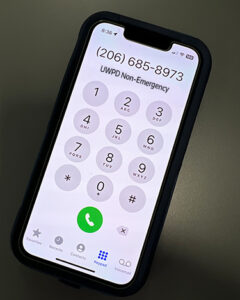
Black iPhone phone showing UWPD's non-emergency number on the screen, 206-685-8973.

If you have an emergency where there’s immediate danger, you should contact 911.

But what if it’s not an emergency? Examples of non-emergencies include:

  • Property crime that happened in the past without suspects nearby, such as discovering your bike was stolen last night.
  • Suspicious people or circumstances that do not pose an immediate risk.
  • Noise complaint
  • Vandalism
  • Lost or found property

If you want to report a problem or concern about something at the UW campus in Seattle that is not an emergency, call the UW Police Department’s non-emergency number. Report a non-emergency: 206-685-8973 (UWPD).

Please use the non-emergency number to contact us instead of email. We may need to get specific information from you about the problem or crime, which is why we ask you to call the non-emergency number instead of emailing UWPD.

UWPD dispatchers answer the non-emergency line 24 hours a day, but emergency calls get priority. You can also report non-emergency crimes online.

We suggest you save the UWPD non-emergency number to your phone, 206-685-8973 (UWPD).

UWPD warns parents about scam calls

University of Washington police are warning parents about scam phone calls that appear on caller ID to come from UWPD. The caller falsely claims the student is in legal trouble and immediately needs money.

UWPD has received multiple reports of these calls recently from parents of student athletes.The caller identifies themselves as a UW police officer or sergeant and says that the student has been stopped or is being arrested. The caller then instructs parents to send bail money via a mobile payment service.

This is a social engineering scam, which tries to elicit a response through fear. Do not provide personal information, money, gift cards or anything of value to the caller. UWPD will never call and request funds. Do not engage with the caller and immediately hang up. If you are concerned, contact the person who the caller claimed was in trouble directly.

If you have been contacted by someone claiming to be from UW police, please call the UW police non-emergency number at 206-685-8973 and report the call to your local law enforcement agency.

False alarm: Swatting calls and AI-assisted scams

In the past year, schools across the country have received an alarming number of false threats and fake reports of active shooters. At UW Seattle, we’re closely monitoring this national trend, as well as emerging scams using artificial intelligence.

Several school districts in Western Washington have gone into lockdown because of bogus threats. Also known as “swatting,” these calls are meant to cause an armed police response and scare students, faculty and staff. UW has not been immune. Early in this past winter quarter UW Seattle received a report of a threat, and with the help of multiple offices, we were quickly able to determine that the threat wasn’t real.

More than 250 colleges, 100 high schools and a number of other K-12 schools have received calls reporting an explosive device or imminent shooting in the past year. In each of these cases, police needed to treat the threat as real until determined otherwise.

Some of the calls reporting threats were computer generated, a strategy scammers are also using. The Federal Trade Commission is warning that scammers are using artificial intelligence to clone voices for calls claiming a family member has an emergency and needs money immediately.

With this new technology a scam call could come in a loved one’s voice. Check to make sure there’s an emergency first before sending money. Resist the pressure to send money immediately by giving over credit card details. Hang up and call the family member or friend just to be sure.

Scammers ask you to pay or send money in ways that make it hard to get your money back. If the caller says to wire money, send cryptocurrency or buy gift cards, and give them the card numbers and PINs, those could be signs of a scam, according to the FTC. Notify your local law enforcement agency if you have been a victim of a potential scam.